How Do Paragliding Competitions Work?
How a task is set and scored, why the heavier pilot starts ahead, how pilots climb the ranking into the big events, and what racing looks like on foot across the Alps or upside down over a lake.
Seven conversations. The scorer who maintains FS, a designer's plan to level the field by weight, one of the founders of the Sports Racing Series, a World Cup winner on learning from the back, two X-Alps athletes and an Acro World Tour champion.
The Seven Conversations
Open any tile for chapters, quotes and links From Tents to Trophies: Understanding Acro Champion's Mindset on Ego, Glory & DrugsLuke De Weert11 chapters
Episode 6474 min
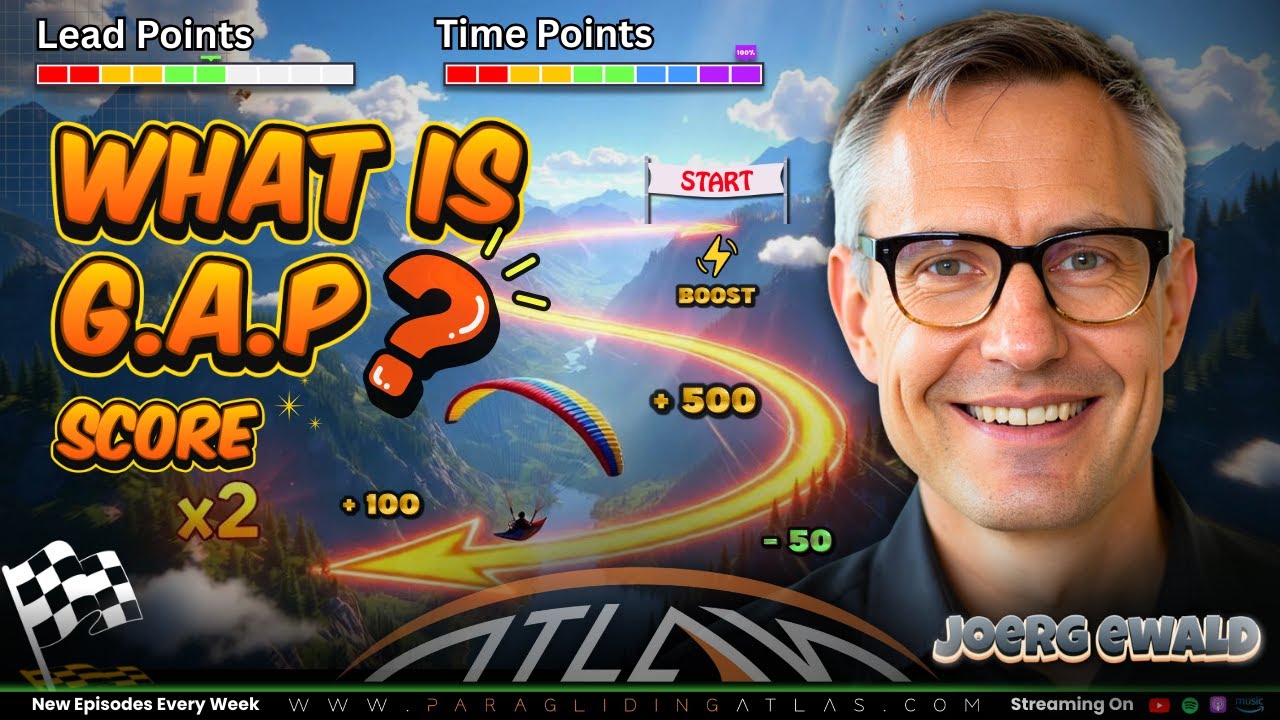 Scoring in Paragliding Competitions: A New Pilot's Guide to the GAP Formula & StrategyJoerg Ewald12 chapters
Episode 6175 min
 The Inside Story of Sports Racing Series (SRS) by Brett Janaway10 chapters
Episode 5828 min
 Bruce Goldsmith explains MRT scoring system and its impact on Paragliding Competitions7 chapters
Episode 4053 min
 Shane Tighe’s Road to X-Alps : Engineering Conquests In The Sky from Australia’s Flatlands to the Pinnacle of Hike and Fly7 chapters
Episode 4740 min
 The Resilience Equation: Erlend Ukvitne’s Unrelenting Path to X-Alps and the Brink of a World Record9 chapters
Episode 1272 min
 PWC LifestyleKlaudia Bulgakow9 chapters
Three Games In Every Task
A task pays for how far you got, how fast you flew the timed section, and how much of it you led. Only the middle stretch is timed, and leading only pays if you are properly out in front.
Read more
Joerg Ewald flew the World Cup from 2004 until he retired from competition in 2025, and maintains FS, one of the programs that implements the GAP formula, named from the initials of the hang glider pilots who designed it. A task is either a race, where everyone waits in the start cylinder and leaves at a set time, or a time trial, where each pilot starts when they choose and their own time counts. Time trials earned a bad name decades ago because they were only set in poor conditions, but he likes them for the different tactics they demand. Either way, only the speed section is timed, from the start of speed section (SSS) to its end (ESS). You still have to fly on to goal for full points, but that last part is untimed.
Inside that frame there are three games. Distance is how far along the course you got. Time is how fast you flew the speed section. Leading rewards progress along the optimised route ahead of everyone else, which is meant to pay pilots who find the climbs rather than follow. In his simulations it only starts to matter at around a kilometre, or a thermal, in front; a lead gaggle flying together scores almost identically. Bad days are partly forgiven by a discard system that crosses out a pilot's worst results. And a turnpoint is missed by metres more often than you would think: the tolerance zone built into big cylinders was being used by pilots as a shortcut, so it has been tightened.
After Joerg Ewald, Episode 64, chapters 5 and 6. Schematic.
The Heavier Pilot Starts Ahead
Between an extra small and an extra large wing the performance gap is around 20 percent. Drag noodles can adjust about 5. Bruce Goldsmith's answer is a bigger turnpoint cylinder for lighter pilots.
Read more
Bruce Goldsmith started competing when every task was open distance and pilots simply flew as far as they could. Now it is all racing, and he argues the range of decisions available in a task has shrunk: massive gaggles run fast along ridges, risk has gone up, and pilots have fewer ways to fly the day differently. The deeper unfairness, in his view, is weight. Across the 100 to 125 kilo range the performance difference is about 5 percent, which the drag noodles being debated can adjust. Between 65 and 125 kilos, extra small against extra large, it is more like 20, and no noodle covers that. Weight classes were tried and made it worse: everyone simply ballasted to the top of their class.
His multi radius turnpoints give lighter pilots a larger cylinder at each turnpoint, so they fly a slightly shorter course. In practice nobody gets overtaken by the rule: the heavier pilot pulls ahead on the leg, and the lighter one catches up at the turnpoint. He describes the current format as the unfair one, and MRT as a small boost against an advantage the heavy pilot has all the time. It does not work with leading points, since the lead changes at every turnpoint, so he sees it as a format for mid-level and national competitions. Ewald notes it was discussed for the scoring software, but CIVL and the World Cup see no need, so it is not coming soon.
After Bruce Goldsmith, Episode 58, chapter 3.
People call it unfair, but it is the other way round. Right now the big pilot has an advantage the whole time. A larger cylinder just gives the lighter pilot a small boost to catch up.
Bruce Goldsmith, wing designer Episode 58, paraphrased
One turnpoint, three cylinders: the lighter the pilot, the larger the radius and the shorter the course.
The Ranking Is The Entry Ticket
Category one means world and continental championships only. The popular category two events are oversubscribed and fill from the world ranking, so a first season is about choosing competitions you can place in.
Read more
Ewald's map of the ladder is simple. Category one events are only the world and continental championships; everything else is category two. The popular category twos attract the strong pilots and are usually overbooked, so organisers take, say, the top 120 of the pilots who registered by world ranking, and if you are below the line your chances are small. That means a new pilot should pick events that are not over their head, where they can finish well enough to climb the ranking, rather than turning up at a big event to finish near the bottom and stay there.
Brett Janaway co-founded the Sports Racing Series around 2012, when a few organisers agreed over a beer to link their events into one series. He describes a deliberate balance: elitist enough to attract several top-100 pilots, open enough for anyone to try. The coming season has six events spread across the world, and two events are enough to maximise a season's score. After a survey of competition pilots, the series proposed flying ordinary EN wings with two limits: an aspect ratio cap of 6.7 to stop manufacturers recertifying high-aspect designs into the class, and a speed limiter to stop pilots making the wing faster than it is meant to go. He is candid that inclusivity has limits: a field needs a similar level to stay safe.
The Back Of The Field Is A Classroom, If You Ask
Pilots expect a competition to teach them and go home frustrated from the back. Klaudia Bulgakow's answer: watch, land, find the top pilots at the bar, and ask. And listen to the voice that says land.
Read more
Klaudia Bulgakow came to flying from competitive sport and found paragliding had no coach to tell you when you were ready. In her first competition season, in 2004, a top Russian World Cup pilot who had been a ski coach saw her trying to fly the comps as cross country, explained the tactics and debriefed her every day. Her advice to newcomers follows from that: treat the first competitions as an adventure and a learning process, observe the pilots ahead, and afterwards go and ask them questions. Some will answer. Arriving with high expectations is how people end up frustrated at the back.
She is just as frank about overconfidence. By the 2009 World Championship in Valle de Bravo she was, in her words, a self-confident and slightly arrogant young pilot on a competition wing with her first World Cup wins, ignoring signs that she was not yet where she thought. Looking back, rough conditions she had not enjoyed at an earlier World Cup were a warning to do more homework first. Her rule now: if something inside says one more thermal is not a good idea, that is probably intuition, not laziness, and it is worth listening to. Ewald's advice for a first competition points the same way: do not race. Fly as far as you can, and think about speed once the distance game is working.
Racing On Foot, And Competing Upside Down
The X-Alps is won as much on the hike as in the air, and an acro title is built in the gym and in the head. Three athletes on what those formats actually ask of a pilot.
Read more
Shane Tighe went from engineering in the Australian flatlands to fifteen years of flying across the Himalayas and on to an X-Alps start line. He arrived relaxed, with friends as supporters, and only at the end wished he had checked out more of the route. He likes supporters who keep him company and feed him options, while making his own flying decisions. Erlend Ukvitne, who began flying in Trondheim in 2018, is candid that fitness was his strongest card but that these races are never won on the ground; he spent four summers in the Alps learning the air. In one prologue, slow conditions put him on the ground halfway and he had to hike back up and switch to patience. His 24-hour vertical record attempt, he points out, has no official rules at all, not even a requirement to carry a reserve.
Luke de Weert finished fifth in his first Acro World Tour season and set out to win it, which he did in 2023, a year after a crash in a storm. He trained core and forearms above all, and used visualisation to rehearse every step from leaving hospital to winning. On bodies and gear he is measured: very short arms are a disadvantage, heavy pilots make a wing more dynamic and break lines sooner, light pilots tend to downsize too far, but genetics do not decide titles. It is not Formula One, he says, where the best car wins.
Worth Remembering
Each one links to the chapter where it is saidPick events you can place in
Popular category two competitions are oversubscribed and fill from the world ranking, so a low ranking keeps you out of the events you want. Joerg Ewald's advice is to choose competitions that are not over your head, finish well, and let the ranking open the next door. Category one, the world and continental championships, can wait.
Joerg Ewald Practical advice for your first competitionScoring
Only the speed section is timed
From SSS to ESS. After ESS you still need goal for full points, but the clock has stopped.
Joerg Ewald Why the start is called the SSSLeading needs a real lead
It starts to count at about a kilometre or a thermal ahead. In the same thermal, it is a wash.
Joerg Ewald How distance, speed and leading points decide the winnerA bad day can be dropped
The discard system crosses out part of a pilot's worst results, which is how some podiums survive a bomb-out.
Joerg Ewald The discard system, and why a bad day gets droppedFairness
Weight is worth up to 20 percent
Extra small against extra large. Noodles cover the 5 percent at the heavy end.
Bruce Goldsmith What multi radius turnpoints actually areWeight classes backfired
Everyone ballasted to the top of their class, the opposite of the point.
Bruce Goldsmith What multi radius turnpoints actually areLimit the wing, then the pilot
The SRS proposal: EN wings capped at aspect ratio 6.7, plus a speed limiter.
Brett Janaway Trying to create a safe CCC wingYour first comps
Do not race yet
Fly as far as you can. Speed comes once the distance game works.
Joerg Ewald WPRS, and ranking the world's pilotsAsk the pilots who beat you
Watch, land, find them afterwards and ask. It is where the learning is.
Klaudia Bulgakow What people assume competition meansRecce the route
Tighe's one regret from the X-Alps: not checking out more of the course beforehand.
Shane Tighe Enjoying the race instead of feeling the pressureQuestions These Conversations Answer
Each answer links to the chapter of the episode where the guest says it.
How are paragliding competitions scored?
With the GAP formula, named after the hang glider pilots who designed it. Joerg Ewald, who maintains the FS scoring software, describes three games in every task: distance for how far along the course you got, time for how fast you flew the speed section, and leading for progress along the optimised route ahead of the field. Each task's points are then added across the competition.
Joerg Ewald How distance, speed and leading points decide the winnerWhat is the difference between a race and a time trial?
In a race everyone waits in the start cylinder and leaves together at a set time. In a time trial each pilot starts when they choose and their own time counts. Ewald says time trials got a bad name decades ago from being set in poor conditions, but a newer pilot can start early and watch the top pilots come past instead of losing them at the start.
Joerg Ewald What a task really is, and how race and time trial differHow do leading points work in paragliding?
They reward progress along the optimised route ahead of everyone else, to pay the pilots who find the climbs rather than follow. Joerg Ewald's simulations show they only make a real difference at around a kilometre, or one thermal, in front. A lead gaggle that flies together gets nearly identical leading and time points, which is why those races finish so close.
Joerg Ewald How distance, speed and leading points decide the winnerWhat is the discard system in paragliding competitions?
A way of forgiving bad days. Instead of every task counting in full, part of a pilot's worst results is crossed out, and some tasks are counted at a reduced value. Ewald calls the maths beautiful but hard to follow, and says it is why a pilot can bomb out on the last day, score a few hundred points, and still keep a medal.
Joerg Ewald The discard system, and why a bad day gets droppedWhy do pilots miss turnpoints by a few metres?
Because instruments and scoring software can disagree slightly about where a cylinder edge is. A tolerance was built in so that when a pilot's instrument showed them inside, the scoring would agree. Ewald says pilots learned about that zone and started turning inside it, relying on the tolerance rather than their instrument, so it has been tightened. Fly clearly into the cylinder.
Joerg Ewald GPS tolerance, and why a turnpoint gets missedWhat are multi radius turnpoints in paragliding?
Bruce Goldsmith's proposal for levelling the field by pilot weight. Lighter pilots get a larger cylinder at each turnpoint, so they fly a slightly shorter course to offset the performance a heavier wing carries. Leading points cannot be used with it, because the lead changes at every turnpoint, so he sees it mainly as a format for national and mid-level competitions.
Bruce Goldsmith What multi radius turnpoints actually areDo heavier pilots have an advantage in paragliding competitions?
Yes, according to Bruce Goldsmith, and a large one. Across 100 to 125 kilos the performance difference is about 5 percent, which drag noodles can adjust. Between an extra small and an extra large wing, roughly 65 against 125 kilos, it is more like 20 percent. Weight classes were tried and failed because everyone ballasted to the top of their class.
Bruce Goldsmith What multi radius turnpoints actually areHow do I get into a Category 2 paragliding competition?
Through the world ranking. Joerg Ewald explains that the popular category two events are overbooked and often simply take the top 120 registered pilots by ranking, so a newcomer below that line rarely gets in. Build your ranking at events that are not over your head. Category one, the world and continental championships, is a later step.
Joerg Ewald Practical advice for your first competitionWhat is the Sports Racing Series in paragliding?
A racing series that Brett Janaway and a few organisers started around 2012 by linking their events. It aims to be elite enough to attract top-100 pilots yet open to anyone. The coming season has six events around the world, and two are enough to maximise a season's score. Its proposed wing rule is EN wings capped at aspect ratio 6.7 with a speed limiter.
Brett Janaway How the SRS started, and early adoptionHow do I learn from my first paragliding competition?
By asking, says World Cup winner Klaudia Bulgakow. Pilots often expect to learn just by entering, then leave frustrated from the back of the field. Her approach is to treat it as an adventure, watch the pilots ahead, and afterwards find them over a beer and ask questions. Some will answer. Low expectations and curiosity get more out of it than results.
Klaudia Bulgakow What people assume competition means