01
Panchgani Tour
to 2027
Starting from[to supply]
Hold a place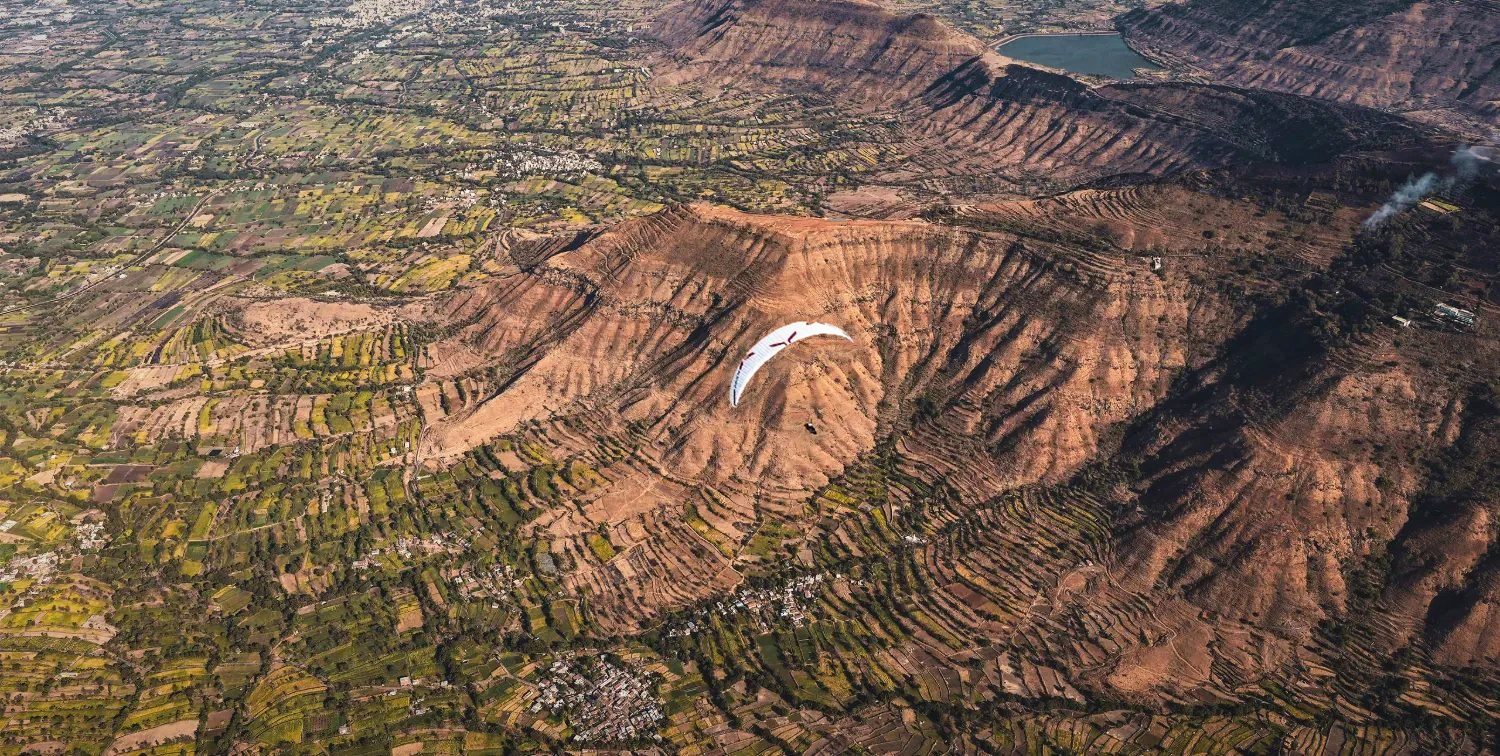
The land of five hills: volcanic tablelands, sharp cliffs and punchy thermals, two hours from Pune.
Photo by Michael Gebert / @flywithandy_paragliding
ScrollPanchgani sits on the Sahyadri, the range that runs down India's west coast about 100 km inland, on the volcanic tablelands of the Deccan: flat tops and sharp vertical cliffs. Vistasp Kharas grew up here and has flown it for more than ten years. He calls it far more technical than Bir: a 30 km flight in Panchgani is as good as 100 km in Bir Billing.
Take-off sits at about 1,100 to 1,200 m, and in the peak of the season pilots climb to 3,000 to 4,000 m, so on a good day the height above the ground beats Bir's.
The cliffs heat through the morning and throw up strong thermals. There are inversions at several layers, the wind can change direction every thousand metres, and each valley and bowl has its own wind.
Every evening the sea breeze comes in from the coast, so the flying day is timed around it. In the time you get for cross country, it is glorious.
November to March. The wind starts from the north-northeast and turns southeast towards spring, so the take-off is chosen to match. The tour flies in February, in the heart of it.
If you get below 1800 meters, start looking for a safe landing. Don't get close to the terrain unless you really know what you're doing.
Panchgani held its first pre World Cup in 2019, with almost 100 pilots, and its second, the first run by the Paragliding Association of India, in 2024. The longest local line runs about 100 km north west to Kamshet.
Eight days in Panchgani, two days after the last Kenya tour ends.
to 2027
Starting from[to supply]
Hold a placeHold a place sends an enquiry for that departure.


Vistasp Kharas walks through Panchgani ahead of the pre World Cup held there, covering what the site asks of a pilot and what to expect from competition flying in India.
The answers on the site come from Vistasp Kharas, on the show. If yours is not here, ask it on the call.
Pilots who can take off in strong wind and strong thermic conditions. Vistasp Kharas, who has flown Panchgani for more than ten years, advises an SIV course: the thermals can be punchy and there is wind in the mix. He would not send a pilot used only to alpine air with little knowledge of wind, because on the lee side the site is not forgiving.
The pilot rating for the tour is [to supply].
A high B or a C is great, and even a low B does well; an A will be a bit frustrating. Do not bring your best wing: the take-off at Harrison's Folly is red dust, and the local pilots keep a second wing that is already red.
Take-off is at about 1,100 to 1,200 m, and in the peak of the season pilots climb to 3,000 to 4,000 m. The local rule: below 1,800 m, start looking for a safe landing, and stay off the terrain unless you know exactly what the wind is doing.
Top landing on the main tableland is forgiving late in the afternoon, once you know where the wind is from. In the valleys, land near a road in a field that has been cut: never standing crops or sugarcane. The power lines are above ground, so look for the poles and their shadows. The villagers are friendly, and a shared jeep back to town is cheap.
Panchgani is about two hours by road from Pune and four and a half to five hours from Mumbai. No train goes to Panchgani: take the train from Mumbai to Pune, about four hours, then a taxi or a bus.
What the tour price covers is [to supply].
The deposit, when the balance is due and what happens if you cancel are all in the booking terms. Read them before you book, and take out trip cancellation insurance.
Ready To Touch The Sky With Glory?
Whether you're a 10 hour pilot eyeing your first 50 or a longtime sky veteran chasing your next world record, we specialize in turning ambition into airtime. This relaxed no-expectations intro call helps you cut through the unknowns with straight talk.
We'll break down: